LaTeX papers
paper workspaces use tufte-latex
(tufte-handout or tufte-book) with the team package
standards/latex/teamtufte.sty on top.
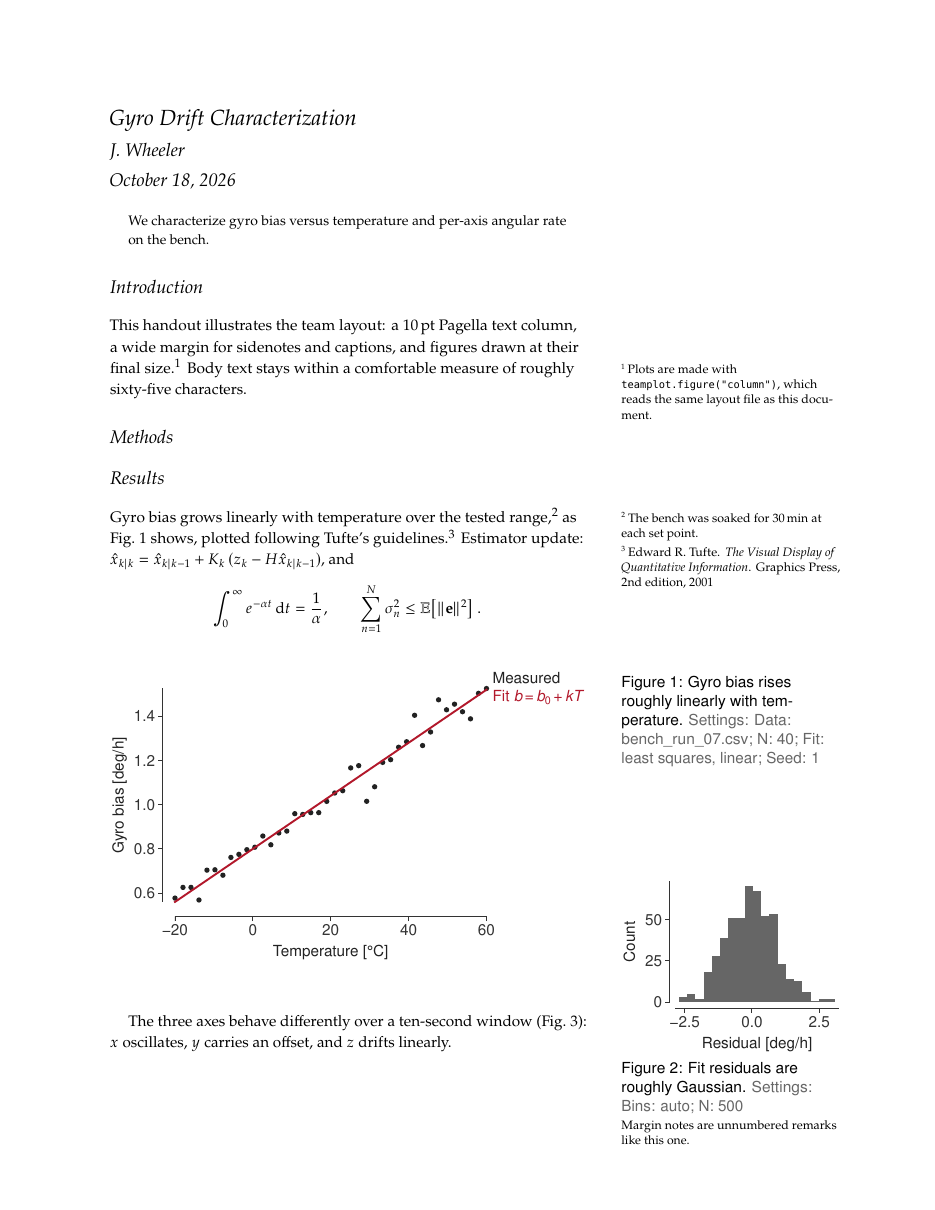
First page of a tufte-handout workspace.
Typography
Element |
Font |
Size |
|---|---|---|
Body |
Pagella (Palatino clone, |
10 pt / 14 pt leading (tufte-latex native) |
Math |
|
10 pt |
Sidenotes, margin notes |
Pagella |
8 pt (tufte default) |
Captions |
Nimbus Sans ( |
10 pt |
Plot and diagram text |
Nimbus Sans |
10 pt |
Code |
Bera Mono, scaled 0.85 |
Why these: Pagella is Tufte-latex’s own default family and has complete matching math (including bold math and blackboard bold) under pdfLaTeX and, via TeX Gyre Pagella Math, under LuaLaTeX/XeLaTeX. Nimbus Sans is a free, metric-compatible Helvetica that installs easily on Windows, and both fonts come from URW, so they sit well together.
The body uses tufte-latex’s native 10 pt size and page geometry, so everything else in the class (margin notes, running heads, full-width figures) behaves as its authors designed. Captions are set in 10 pt Nimbus Sans so they match plot text.
Layout
Letter paper, tufte-latex’s native geometry: 1 in left margin, 26 pc (312 pt) text
block, 2 pc gap, 12 pc (144 pt) margin column. Defined in
standards/latex/layout.tex, shared with teamplot.
Writing in the Tufte style
Main argument goes here.\sidenote{Numbered aside, set in the margin.}
\marginnote{Unnumbered remark in the margin.}
Results agree with prior work.\cite{smith2024}   % a numbered sidenote, after punctuation
Need |
Use |
|
|---|---|---|
Normal figure (caption in margin) |
|
|
Small figure in the margin |
|
|
Wide figure |
|
|
Table |
|
|
Units |
|
|
Cross-reference |
|
|
Placeholder |
|
|
Bibliography |
|
hidden until the first |
Always include figures with \teamfig{name} and put settings in the caption with
\figsettingsof{name}:
\begin{figure}
  \teamfig{bias_vs_temperature}
  \caption{Gyro bias rises roughly linearly with temperature.
    \figsettingsof{bias_vs_temperature}}
  \label{fig:bias}
\end{figure}
\teamfig[<includegraphics keys>]{name} uses figures/annotated/name.pdf if present,
else figures/name.pdf; includes it at natural size, capped at \linewidth; and warns
on stale annotations (Annotating figures by hand). \figsettingsof{name} reads
figures/name.settings.tex and shows a red marker if it’s missing.
Building
cd paper
latexmk main.tex      # pdfLaTeX, runs BibTeX as needed
latexmk -c            # clean auxiliary files
paper/.latexmkrc adds ../standards/latex// to the TeX search path and lets
BibTeX’s “no citations yet” error pass on fresh documents.
Overleaf: upload the workspace, set the main document to paper/main.tex,
and copy standards/latex/* and figures/ alongside. Overleaf runs latexmk with the
same .latexmkrc.
article vs report
article→tufte-handout: title block, abstract, sections.report→tufte-book: title page, table of contents, front matter, chapters, alternating (two-sided) margins. Use it for dissertation-style writeups.